Civics and citizenship
Welcome to Civics and citizenship! Why is civics and citizenship important? Review the introduction to the course by Steve Paikin, in the following video.
Explore this!

Explore Steve Paikin’s video introduction to this course.
Nelson Mandela, a freedom revolutionary and the president of South Africa (between 1994-1999) once made a speech in which he stated the following.
A fundamental concern for others in our individual and community lives would go a long way in making the world the better place we so passionately dreamt of.”
Explore this!
In the following video, Matthew Coon Come, Former National Chief of the Assembly of First Nations, shares words of how important it is to keep Indigenous voices in mind for this Civics classroom.
Civics terms and definitions
New words and terms will be briefly defined in the learning activities. These terms (and related others) will be shown in boldface, and are listed in the following Civics Terms and Definitions(Opens in new window). You may want to print this out and keep it nearby as you progress through the course. It will definitely support your learning.
Civics, politics, and government
In Unit 1, you explore ‘civic awareness,’ but what does that mean?
Definition

Civic awareness
Civic awareness is the knowledge and mindset that makes an individual decide to take an interest in civic action; participate in elections; support community planning and activities; volunteer; and feel connected to other citizens globally or in the community.
Most people have a private life and a public life. Civics is part of a citizen’s public life. Civic life is concerned with all of the ways citizens can live respectfully together in public (the community and nation).
Politics is the process that’s used to make formal, civic decisions.
People have different ideas about how politics should work. In an ideal world, it would be great to get everyone together to make a decision. However, in a country like Canada (which has about 38 million people), that is unrealistic. When groups of people live together but have different opinions and interests, political systems are created to help them make collective decisions.
Early ideas on governance
In the 16th and 17th centuries, not every citizen could have a voice in every decision made, so different ideas developed about how to govern. These ideas were rooted in the different ways of thinking about human nature that predominated at that time.

Thinkers in other cultures took perspectives that were unique to their world view. You will touch on Western and Haudenosaunee ideas of governance, but these are only a small sample of the views surrounding governance. You are encouraged to explore how other communities are governed across the globe.
Politics in Canada originates in Indigenous and Western European understandings of leadership. While disagreements between these perspectives persist, each contributes to the Canadian understanding of good governance. Some notable influences include Thomas Hobbes, John Locke, and the Haudenosaunee confederacy.
Press on each of the following headings to find out more about the different ways in which Hobbes, Locke, and the Haudenosaunee people thought about humans and human nature.

Indigenous Peoples in eastern North America developed their own political constitution and models for society. One of these models is known as the Great Law of Peace (Kaianere’kó:wa). The political and cultural alliance amongst the Haudenosaunee was built on the belief that all people had equal value and that, therefore, member nations should have equal representation in the alliance. The five-nation Haudenosaunee Confederacy – also known as the Iroquois League or League of the Five Nations – was founded sometime between 1142 and the mid-16th century.
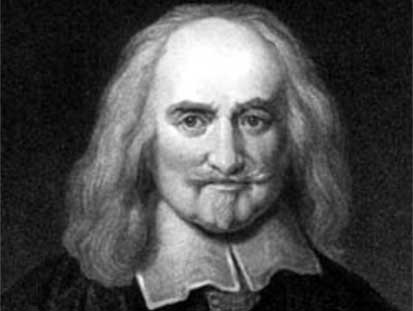
Thomas Hobbes (1588–1679) felt that people tended to be selfish and were mainly interested in achieving their own interests. He regarded this “me-first” attitude as one that often led to conflict, violence, and war. Hobbes thought that people would be better off if they were taught obedience and followed rules enforced by a supreme ruler. He felt that obedience to a higher authority was the best way for society to avoid the chaos of continuous conflict.
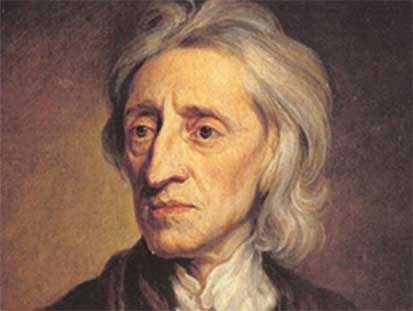
John Locke (1632–1704) believed that humans were naturally good, tolerant, and intelligent. Locke agreed that selfishness and greed were part of human nature, but he felt that people also had a built-in sense of fairness and equality, making it necessary to build choice and participation into government.
Notebooks and journals
For this course you are required to answer most questions in your notebook and for answering reflective questions or ones about self-identity, you will keep a journal. Notebooks and journals may be completed electronically or in paper form. As you come to these items, choose the form that works best for you.
Your Notebook and Journal can be sections of the same folder on your desktop. If you are keeping your work on a digital platform like a drive or website, you can use headings and folders to stay organized.
But what is the difference between a notebook and a journal?
Notebook

Notebooks will probably be a familiar task to you.
The notebook icon will occur when you are asked to consider concept-check or comprehensive questions and/or answer questions based on a text. Your notebook can be written in complete sentences or point form and it will not be submitted. Be sure that your answers are understandable because you may need these answers to help complete assignments and/or prepare for your final test.
Journal

Journals have a different purpose.
Journal questions will ask you to think reflectively and maybe make connections to your self-identity. For example, you may consider a character or a situation and how similar or different your own life may be from that individual and/or circumstance. When you encounter the journal icon, try to make connections to your lived experiences. Journals will not be submitted. Some assignments though will ask you to provide self-reflective sections, so journals help you prepare for those types of answers.
Make sure that the entries for your Notebook and Journal are always identified clearly with the unit and learning activity number and perhaps, a title and date. This will help you stay organized so you can easily find information later, if needed.
Now let’s attempt your first notebook entry next.
Notebook
Respond to the following questions in your notebook.
- Do you agree more with the Haudenosaunee Confederacy, Hobbes', or Locke's view of people? Explain your thoughts and ideas.
- List three things in today’s society that support your perspective.
For this learning activity, you will:
- explore ideas of citizenship
- understand the difference between a journal and a notebook for this course
- learn about types of governance
- understand the inquiry process and political thinking concepts
So, let’s get started.
Citizens' rights and responsibilities

There are a range of political systems in the world today. These typically fall along a political spectrum from authoritative regimes to democratic systems.
In authoritative regimes, designated leaders make the decisions, rules, and laws. Citizens have limited rights and responsibilities and they are expected to obey leadership without question.

Madeleine Dion Stout addressing guests at a dedication ceremony for a stained glass window in Parliament Hill to commemorate the legacy of residential schools as part of a movement to rectify Indigenous Peoples' rights in Canada
In democratic systems, citizens have a voice in making decisions, rules, and laws. Decisions reflect the will of the majority. The government is limited in its power and must respect people’s rights.
Today, democracies come in many shapes and sizes, but most of them have the following characteristics in common. Press the following tabs to learn about each characteristic.
Notebook
Respond to the following questions in your notebook.
- Rank the characteristics of democracy in order from most to least important. Compare your list to another and compare justifications for why you have put them in the order you have chosen.
- Choose three characteristics that you can agree are the most important. How are these characteristics protected (or not) in your community?
What is the inquiry process?
In order to explore civics, you will use the inquiry process.
You will be using this process to investigate events, developments, and issues; find solutions to problems; reach supportable conclusions; and develop plans of action.
The inquiry process has the following five basic components: formulate questions; gather and organize; interpret and analyze; evaluate and draw conclusions; and communicate. You usually begin the process by formulating questions. However, you won’t always follow these steps in this order.
For example, you can do the following:
- start with a question, and then gather and analyze information and evidence to investigate it;
- start with evidence and analyze it to draw conclusions, and then ask questions to clarify your findings using the other steps; or
- use the entire process.
Explore the following interactive to analyze the different steps of the inquiry process.
Press here for an accessible version of the Inquiry Process document. (Opens in new window)
Press the Start button to access the interactive. This interactive will open in a new window.
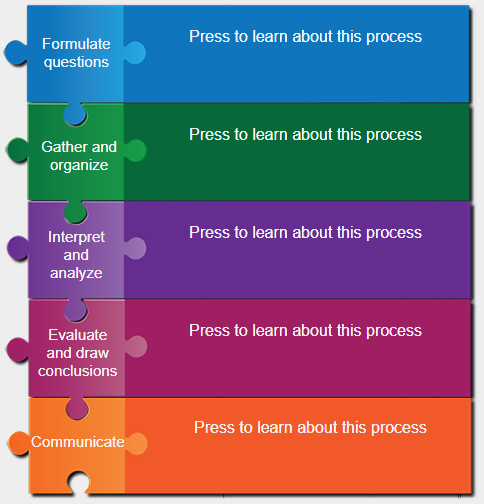
When you do an inquiry using this process, you will find that it will not always result in one “right answer.”
In order to evaluate your effectiveness as your inquiry proceeds, you’ll need to pause and reflect after each step, as you may need to adjust your process before continuing.
For example, consider the following:
- When you formulate questions, check that they are relevant before moving on to the next step.
- When you gather and organize information, check that your evidence is accurate.
- When you interpret your evidence, verify the logic of your analysis.
- When you begin to form conclusions, ensure that you can support them with strong evidence.
- You will be communicating throughout the inquiry process, so make sure that your communication is always clear and specific.
Political thinking concepts
Along with the inquiry process, you’ll use four concepts of political thinking as guides, to help you focus on relevant questions. The four political thinking concepts are as follows: political significance; objectives and results; stability and change; and political perspective.
Each concept gives you a different lens through which to analyze and filter your information, allowing you to examine issues and evidence in a number of different lights. Explore the following interactive to know more about the political thinking concepts.
Press here for an accessible version of Political Thinking Concepts (Opens in new window)
Press the Start button to access the interactive. This interactive will open in a new window.
Summary: Political thinking concepts
Press the following tabs to explore the summary of the political thinking concepts you have just learned about.
I can use the concept of political significance, through the inquiry process, to do the following:
- explain how people, ideas, and events contribute to political change in society
- analyse the degree to which political decisions represent turning points
- assess the impact of a political decision or action made by a governing organization on a variety of stakeholders
- evaluate how the importance of political actions/decisions may shift for various people and over time
I can use the concept of objectives and results, through the inquiry process, to do the following:
- identify the intended rationale(s) or motive(s) for political responses to issues
- explain how political events or developments can be caused by multiple factors
- assess the intended or unintended effect(s) or outcome(s) of a decision
- evaluate the consequences of a political decision on various groups in society
I can use the concept of stability and change, through the inquiry process, to do the following:
- explain links between past and current political policies, decisions and responses
- determine the degree to which government policies may create or prevent political change
- analyse the reason(s) for political continuity and variation over time
- assess alternative approaches to political institutions to resist or support change
I can use the concept of political perspective, through the inquiry process, to do the following:
- identify the influence of beliefs/values on people’s political viewpoints and actions
- analyse the factors that influence how and why people push for political change
- compare and contrast how different groups respond to the same political issue
- evaluate political courses of action from the viewpoint of key stakeholders
Source:
Government of Ontario (2013). Social Sciences and Humanities (2013). Curriculum and Resources. Retrieved July 27, 2022, from https://www.dcp.edu.gov.on.ca/en/curriculum/social-sciences-humanities
Notebook
How do the four political thinking concepts affect the decisions that are made in your community?
What if your community wanted to build a new highway through a busy neighborhood? The highway would help people in the community access a new business that would create a lot of jobs. Consider how each lens would view this decision. Answer the following questions in your notebook.
- To whom would the new highway be of political significance?
- What objectives and results would the highway satisfy?
- What impact would this change have on the community?
- What different political perspectives may there be about this decision?
Exploring the inquiry process
Take a break!

Great work! So far, you've explored the concepts of civics, governance, and political thinking. In the next sections, you will continue to learn more about the inquiry process. Consider taking a break before continuing your learning.
The political inquiry process can help you explore a topic you are interested in, making it easier for you to have an impact when you become actively involved. To become better acquainted with the process, let us explore the process’ steps in more detail in the following section:
Formulate questions
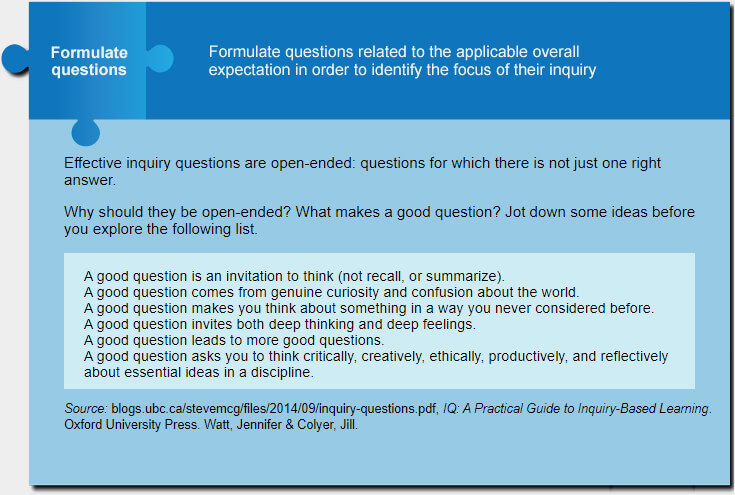
Explore the following interactive to learn more about formulating questions.
Press here for an accessible version of Formulate Questions. (Opens in new window)
Press the Start button to access the interactive. This interactive will open in a new window.
Examples of inquiry questions
Following are some examples of good civics inquiry questions:
- Why is civics important?
- If you didn’t live in Canada, would you want to? Why, or why not?
- Am I a good citizen?
- How should our government work?
- How should we balance individual rights and the common good?
- What do you think are the non-negotiable attributes of a democracy?
With questions like these, there isn’t just one correct answer. You have to work to determine what the correct answer is based on your own understanding. This process builds skills and abilities.
Notebook
To get some practice in choosing and creating effective questions for inquiry, explore the following examples. Respond in your notebook, then press “Show Suggested Answers” to check your work.
Which of the following questions would make a good inquiry question, and which are not so effective? Explain your decisions.
-
Who was the first Prime Minister of Canada?
This is not a good question for inquiry because it can be answered in a few words, with known facts. It’s a closed question, so additional work may not turn up any new information or insight. A more effective question might be, “Do you think that Sir John A. Macdonald was a good Prime Minister?” This allows you to express an opinion and try to support it.
-
Who do you think was the best (or worst) Prime Minister of Canada? Support your opinion with evidence.
This is a better question for inquiry because there is more than one possible answer. You could find evidence to make an argument in support of a number of different answers. Although this question is not very original and has probably been studied before, your inquiry, evidence, and interpretation may add some new information, new insight, or a new point of view.
-
How should Canada address historical wrongs done to Indigenous Peoples?
This question meets the criteria for a good inquiry question because there is more than one possible answer. It requires research to find evidence to support a position.
-
How have harmful government policies regarding Indigenous Peoples affected Canada and Canadian identity?
This is a less effective research question because it only requires you to list examples and not make a judgement. A better question to ask might be, “Which action taken by the Canadian government against Indigenous Peoples has had the largest impact on Canada and the Canadian identity?” This question allows for multiple answers which can be supported and debated.
Gather and organize
An inquiry process is used in most subject areas and even in most business contexts. Following the process helps ensure that you’re asking meaningful questions and using appropriate sources to find the evidence and answers you need.
After you have formulated a good question, the next logical step in an inquiry is to gather and organize information, in order to find evidence to answer your question.
Continue your exploration of the inquiry process by learning more about gathering information in the following section.
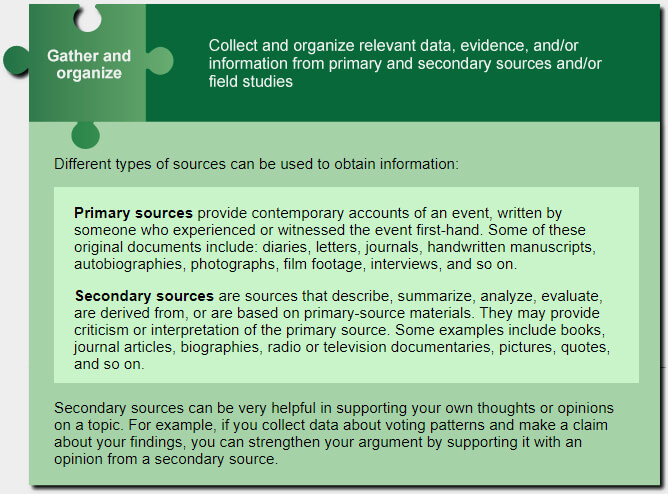
Explore the following interactive to learn more.
Press here for an accessible version of Gather and Organize. (Opens in new window)
Press the Start button to access the interactive. This interactive will open in a new window.
Research using primary sources
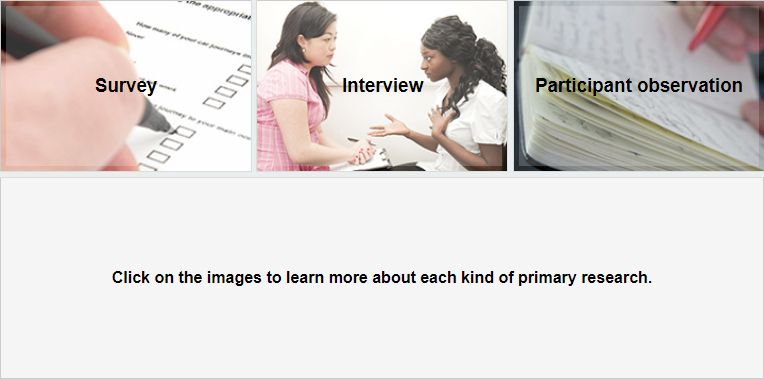
Primary source research can involve collecting raw data on a specific topic directly from the source. In other words, the researcher obtains the original data from the source first-hand. Tools used to collect data from primary sources include surveys, interviews, and participant observations. Explore the following interactive to know more.
Press here for an accessible version of Primary Research Tools. (Opens in new window)
Press the Start button to access the interactive. This interactive will open in a new window.
Research using secondary sources
Secondary research is so-called because the information you’re working with is not first-hand information; it was collected and reported by another researcher and comes to you second-hand.
You do secondary research by consulting resources such as books, journals, articles, or videos that have been developed by others. Based on the information you discover, you can draw conclusions or develop plans for further research.
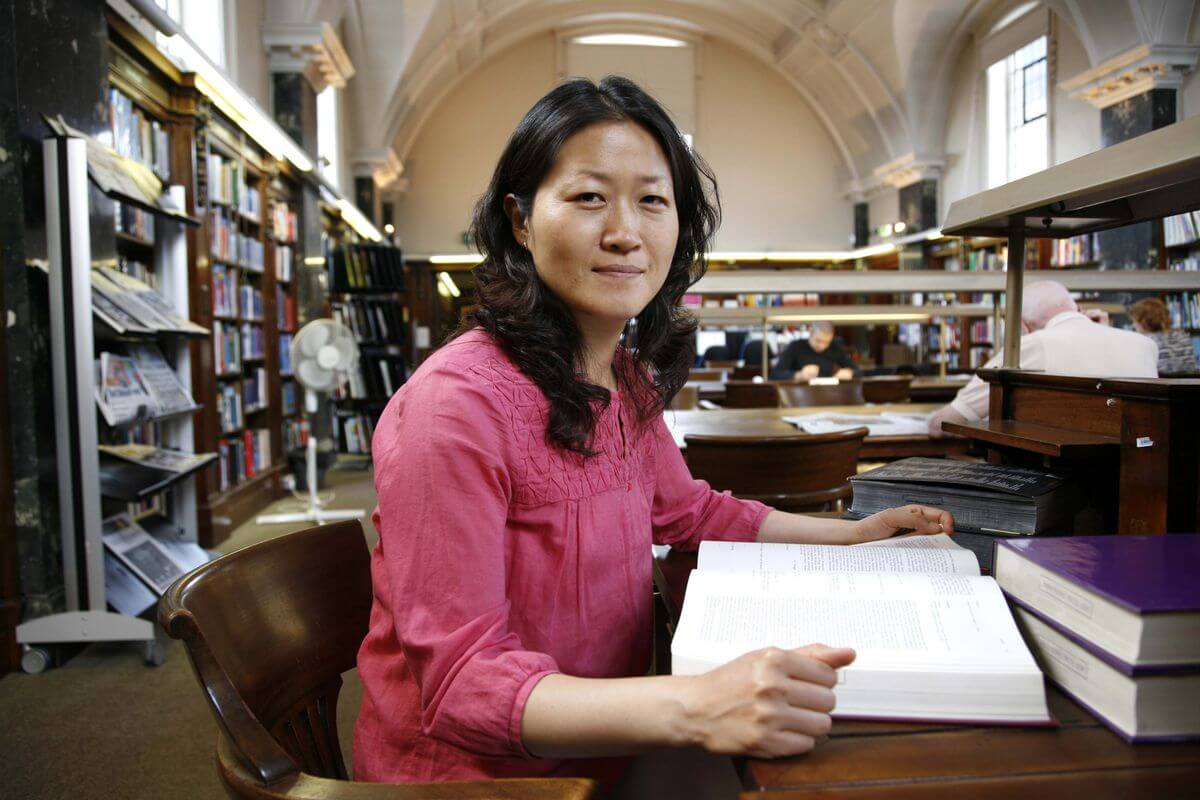
For example, if you’re interested in determining how a specific age group affects community participation, you could search for relevant information in articles found at libraries, or online. By consulting secondary sources, you’re studying what others have done and learned, before setting out to collect your own data.
Check your understanding
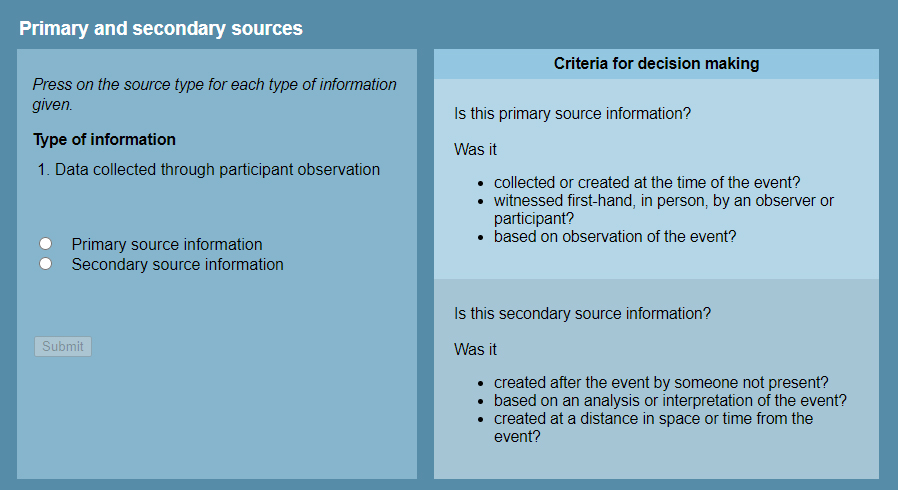
Using what you’ve just learned, determine whether the type of information detailed in the following activity would be considered a primary or a secondary source. Access the following interactive entitled Primary and Secondary Sources to check what you may already know about these concepts.
Press here for an accessible version of Primary and Secondary Sources. (Opens in new window)
Press the Start button to access the interactive. This interactive will open in a new window.
Locating sources
Some primary source information, such as that found in original letters, diaries, or photos, is available in reference libraries or archives. You’ll find plenty of secondary sources in databases, in online articles, and in libraries.
Following is a list of common places to search for secondary sources. Press the following tabs to learn about each place.
Checking sources
When you select secondary sources, you need to check that the information in them is valid and accurate.
Press each tab to know what you need to question while judging the sources you plan to use.

Accuracy means making sure that something is true, correct, and valid. If you refer to any false information, your interpretation of the information may also be questionable. Ask questions like the ones that follow when trying to determine whether information is accurate:
- Who produced the document? Do the authors have credibility or authority?
- Where did the information come from? Was it from a reputable source?
- Is the information first-hand knowledge from a primary source, or is it a summary created after the fact?
- Does the information match or contradict information that you already have on the topic? If there are contradictions, are there logical reasons for this?
Facts are unbiased pieces of information about reality. Facts are objective; they have been proven and are not arguable. For example, it’s a fact that Indigenous Peoples in early Canada governed themselves before Europeans arrived. That’s accepted as a fact because there is physical evidence to back it up.
Opinions are judgements, not facts. They are views or interpretations of events based on evidence, but they have not been proven beyond a doubt. Opinions are subjective and arguable. For example, “Indigenous Peoples in early Canada welcomed Europeans” is an opinion, because arguments could be made to support or counter this statement.

Bias is the presentation of an issue from a single, subjective point of view. Biased statements can persuade uninformed people to adopt opinions they may not otherwise hold. Ask yourself the following questions to determine whether a source is biased:
- Who wrote the document, and why? An unbiased source would have a credible author with no hidden agenda.
- Where did the information come from? Was it from a reputable source?
- Was the author or organization closely involved in the event being described? Could that have affected what was written?
Did you notice that some of the questions about bias are similar to those related to checking for accuracy? Misrepresentation caused by bias can easily result in an inaccurate or distorted understanding of a subject.

Identifying the author’s purpose is important, when judging sources. Ask some of the following questions to clarify the author’s purpose:
- Who are the authors?
- Are they educated in the subject matter?
- Are they qualified to write about their subject material because they attended the event, or because they got involved in the issue as a witness, participant, survivor, or beneficiary?
- Are they employed by an objective institution, such as a university or research centre?
Fake news
With many people using social media and the Internet to get their information, there is a question of accuracy and the quality of news shared with audiences since many news organizations, platforms, and websites prefer to produce content quickly, and they may not check all sources.
“Fake news” is a reality, and it is becoming increasingly difficult to figure out the truth. There is so much information being shared and for you, this could be misleading unless you carefully consider the source.
It’s important for you to be diligent when it comes to figuring out news media truths from fiction. Checking for a source's accuracy, facts, bias, and purpose is a great start as is being aware of the types of false information you may encounter.
There are three terms defining the types of misleading information you may discover when searching through news media resources.
Definition
Disinformation
Information that is false and deliberately created to harm a person, social group, organization, or country. An example would be a politician posting negative info about their main competitor to gain votes.
Misinformation
Information that is false but not created with the intention of causing harm. An example would be someone posting a news article with outdated data.
Mal-information
Information that is based on reality, used to inflict harm on a person, social group, organization, or country. An example would be someone posting a picture (with no context) as in a picture of a vegetarian eating meat in 2007 that is now shared as a current photo to discredit that person’s character.
Source:
UNESCO. (2021, May 7). Journalism, “Fake News” and Disinformation: A Handbook for Journalism Education and Training. United Nations Educational, Scientific and Cultural Organization (UNESCO). https://en.unesco.org/fightfakenews
Citing sources
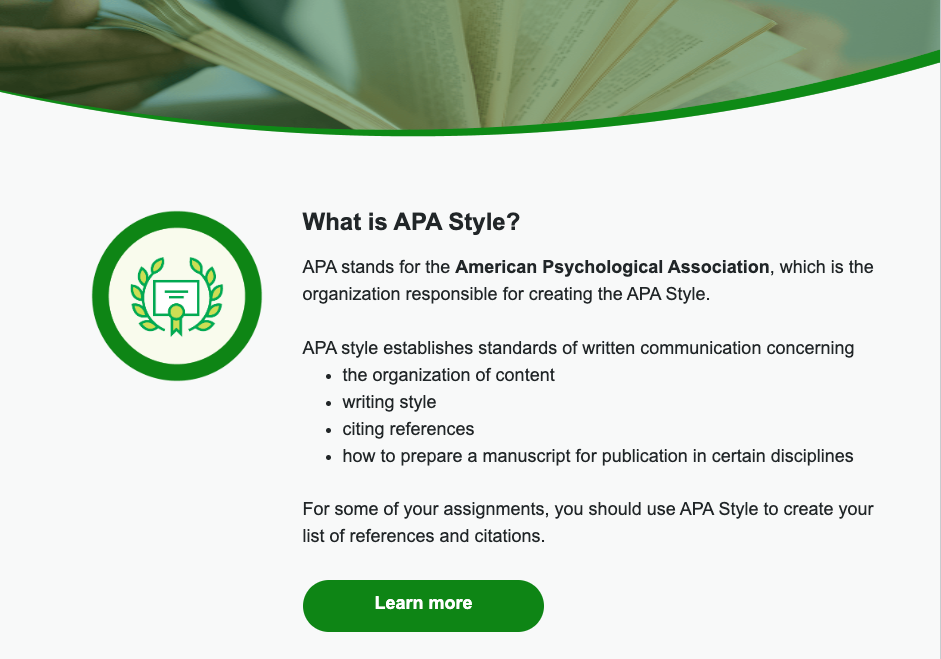
Now that you have some background on how to gather information as part of your inquiry, the following is your chance to give it a try.
Journal
Find two people in your community who are willing to participate in this activity – in person, on the phone, or online. Conduct a short interview with each of them by asking the following question, “What do you think are the five most critical issues affecting the world today?”
Use a data collection sheet to record their responses. Use the Data Collection Sheet: Civics Inquiry (Opens in new window) as an example.
Note that, because this information is being gathered first-hand from participants in the inquiry, it is considered primary source data.
You’ll work with primary source data you collect, as you explore the remaining steps in this inquiry.
Reflect on how recording the information in a chart helps you to understand it? Next time, how will you change your chart so that it is easier for you to work with?
Interpret and analyze
Once you’ve gathered and organized your information, the next step in the process is to interpret and analyze the findings.
Explore the following interactive to learn more.
Press here for an accessible version of Interpret and Analyze. (Opens in new window)
Press the Start button to access the interactive. This interactive will open in a new window.
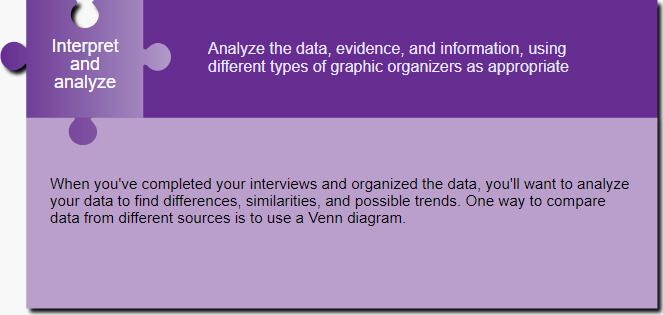
Using a Venn diagram to compare information

Once you’ve gathered your information, you’ll organize it by creating a Venn diagram. On a piece of paper, reproduce the following three overlapping circles. Each circle will contain the interview responses from one of your subjects.
Record the similarities in the overlapping areas, and the differences in the non-overlapping areas. Once you have finished filling in the diagram, move on to the following reflection questions.
- When you’ve filled in your Venn diagram, examine the results. Which issues did your subjects identify as being the most critical?
- Did any of your subjects identify the same issues as being the most critical? If so, what do you think that indicates? If not, what do you think that indicates?
- How could you revise or rerun your inquiry to check your results?
- Did you get any insights into your subjects or the issues raised by conducting this basic research activity? What were they?
Evaluate and draw conclusions
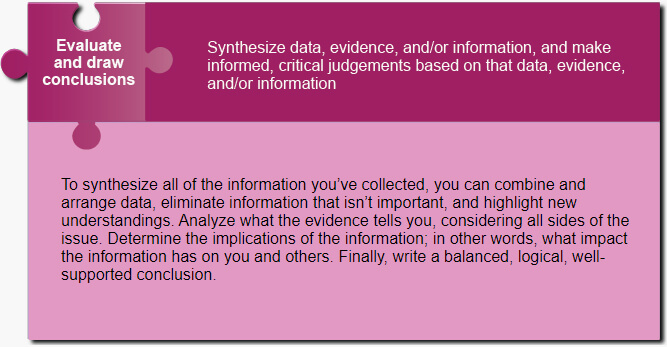
Now that you have a preliminary list of civic issues that are considered significant, you’ll come back to it from time to time, as you work through the course. After analyzing your information, the next step is to evaluate what you’ve found and draw conclusions, based on sound judgement of the evidence.
Explore the following interactive to learn more.
Press here for an accessible version of Evaluate and Draw Conclusions. (Opens in new window)
Press the Start button to access the interactive. This interactive will open in a new window.

Notebook
Once you have finalized your key findings, you need to think about what points to communicate. Reflect on the following quotation by Richard Wagamese in your notebook. What does his comment mean for how you should report the information you have discovered?

There is such a powerful eloquence in silence. True genius is knowing when to say nothing, to allow the experience, the moment itself, to carry the message, to say what needs to be said. Words are less important, less effective than feeling. When you can sit in perfect silence with someone, you truly know how to communicate.”
Source: Embers: One Ojibway's Meditations https://quotefancy.com/quote/2585689/Richard-Wagamese-There-is-such-a-powerful-eloquence-in-silence-True-genius-is-knowing
Communication
You will use the following information about communication to create a plan of action towards the end of this course. At the end of Unit 2, your culminating task titled Creating Change through Action asks you to choose a civic issue and organize research about it including providing possible solutions. For now, make sure you read through the information.
Explore the following interactive to learn more about communication.
Press here for an accessible version of Communicate. (Opens in new window)
Press the Start button to access the interactive. This interactive will open in a new window.
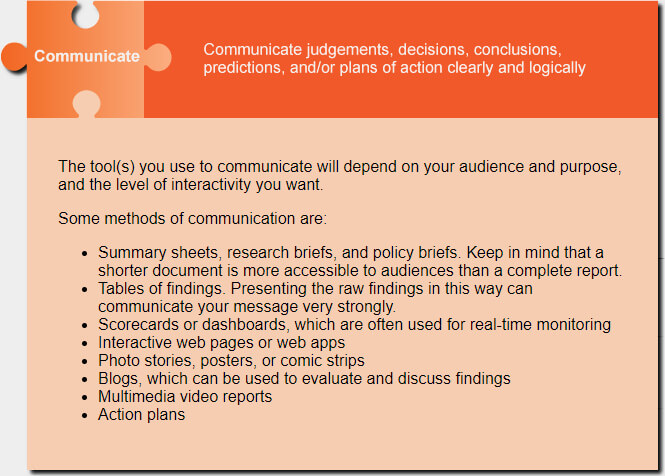
The inquiry process has five basic components, and these steps are interrelated. Using the process in this learning activity, you’ve documented the issues that a small group finds important in your community and/or globally.
These issues may be of use to you in your final activity!
Moving into action
As this course progresses, you’ll choose issues and then use your inquiry tools, knowledge, and skills to investigate them.
By the end of the course, you will have done the following:
- selected one issue that you believe to be significant and interesting;
- researched the issue;
- found out how you can contribute towards the issue; and
- created a plan to help resolve the issue, or at least move it /in the right direction.
For example, you may decide to try to improve political participation within your community, plan to resolve an issue in your neighbourhood, create a plan for an annual celebration in your ommunity, improve recycling and exchange of used objects in your community, or clean up the waterfront. Alternatively, you could focus on a larger issue (such as hunger), a specific group of people (such as the elderly), the work of an organization (such as Habitat for Humanity), a common goal (such as reducing waste), a more effective practice (such as a non-violent protest), or a needed service (such as mental health care for children).
The type of civic issue chosen, and its scope, are up to you!
As you progress through the course, keep the nature of this final assignment in mind. Think about how you can use the processes, skills, knowledge, and tools that you acquire during the learning activities to help you complete your final project.

Housing community service groups are common in many communities across the province
Final thoughts about studying civics
In this learning activity, you’ve started to ask some civics-related questions. You have done the following:
- defined of civics and understood how it relates to politics and government;
- followed the steps in the political inquiry process and began to use it to investigate civic issues;
- identified four political thinking concepts and received information on how they are used during the inquiry process;
- distinguished between a number of data collection methods and used one to collect data as part of an inquiry; and
- distinguished between different types of sources for inquiry.
If you still have trouble understanding the inquiry process, you can always come back and review the information in this learning activity. This will help you as you apply the process within future activities.
Course assignments and marking
There will be four assignments for you to complete in CHV2O plus a final test. Following is a list of the tasks plus how much they are worth in terms of your final mark.
- Learning Activity 1.2 Assignment - Active citizen paragraph 10%
- Learning Activity 1.5 Assignment - What if you ran a country? 15%
- Learning Activity 2.3 Assignment - Persuasive paragraph about a charity 15%
- Learning Activity 2.5 Assignment - Creating change through action 30%
These will be explained in greater detail as you progress closer to each of these assignments.
The final test is worth 30% which will then total 100 marks for this course. It is a bit early to be too concerned about these tasks, but it is good to know how much they are worth in terms of your success.
Journal
This is an opportunity for you to consider your progress. Think about the following questions:
- What have you clearly understood in this learning activity?
- What have you struggled with in this learning activity?
- What remains unclear for you in this learning activity?
- What are your next steps to improve upon your understanding of this learning activity?
Superb work! You are off to a great start having successfully completed the first learning activity. You familiarized yourself with key terms of the course and their definitions. As you continue through this unit and the rest of the course, keep your notebook updated and be mindful of opportunities to apply and develop transferable skills. You’re now ready for the rest of the course!
Self-check quiz

Check your understanding!
Complete the following self-check quiz to determine where you are in your learning and what areas you need to focus on.
This quiz is for feedback only, not part of your grade. You have unlimited attempts on this quiz. Take your time, do your best work, and reflect on any feedback provided.
Press Quiz to access this tool.
Based on your answers, reach out to your academic officer for additional support as needed.
Connecting to transferable skills

Recently, Ontario worked with other provinces in Canada to outline a set of competencies that are requirements to thrive. Ontario then developed its transferable skills framework as a set of skills for students to develop over time. These competencies are ones that are important to have in order to be successful in today’s world.
Read through the framework and the student look-fors (Opens in new window). Copy this document into your notes - you'll refer to it in each unit.
Note the indicators that you think you will develop in this course. At the end of the course, you will revisit these skills to acknowledge which ones you actually developed and if your original predictions were correct.